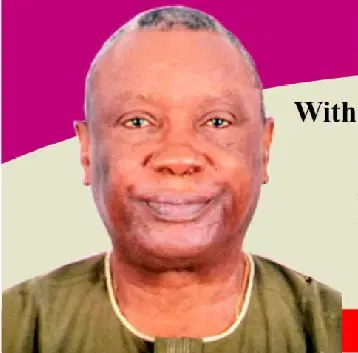
From last week continues the narrative on the Benue-Plateau crisis based on early encounters with Chief Solomon Lar in Jos and Chief Joseph Tarka in Makurdi.
I visited Makurdi for the first time in 1977, courtesy of Chief Joseph Sarwuan Tarka.
On March 30, this year, it was 45 years that Chief Joseph Sarwuan Tarka (July 10, 1932-March 30, 1980) answered the final call. Unfortunately, the issue that he fought against in the last 24 years of his life – the conquest agenda of the Fulanis – still lingers. During his era, the problem was not about herdsmen but the imperialist policies of the Northern People’s Congress, NPC, as dictated by its leadership.
He was a teacher like his father, Tarka Nanchi. His mother, Sera Ikpu Anyam Tarka, a nurse, died in December 2005 at the age of 95. At an early age, he attended the London Constitutional Conference in 1958. Others like him, who were young and from minority parties, who attended the conference included Mr. H. Biriye, Dr. Okoi Arikpo of the United National Independence Party; Mr. P. Dokotri, also of the United Middle Belt Congress; Dr. Udo Udoma of the United National Independence Party; Mallam Aminu Kano, Mallam Ibrahim Imam, and Dr. S.E. Imoke from Itigidi in Cros River State, who later became a minister and married a pretty princess from Sabongida-Ora in the present Edo State. Dr. Imoke was the father of Senator Liyel Imoke, the former governor of Cross River State.
Chief Tarka got elected into the House of Representatives, representing Jemgbar Constituency, by 34,243 votes. He defeated J.I. Ukume of the NPC who scored 1,191 votes and S.C. Sarma of the National Council of Nigeria and the Cameroons, NCNC, who scored 703 in the 1958 election. He then formed his party, the United Middle Belt Congress, along with Patrick Dokotri, David Obadiah Vreng Lot, Ahmadu Angara, Isaac Shaahu, Edward Kundu Swen and others. He entered into an alliance with the Action Group, led by Chief Obafemi Awolowo. He later entered into another alliance with the Northern Elements Progressive Union, NEPU, made up of Mallam Aminu Kano, Yerima Bello,Abubakar Zukogi, Ahmed Tireda, Gambo Sawaba, Ibrahim Heeban, Saliu Tate, Yahaya Abdullahi, Saliu Nakande, Shehu Sataima, Ali Dakat, Ango Soba, Adamu Gaya, Mallam Lawal Dan Bazua, Abubakar Tambuwal, Babadije Jimeta, Alhaji Tanko Yakassai (spokesman) and others.
The primary aim of Chief Tarka was to fight for the independence of the Tivs from the hold of the Northern People’s Congress. That fight led to the emancipation of the people we now refer to as the Middle Belt. It had snowballed into the major crisis which we now refer to as the Tiv Riots of 1960 to 1964. This was at the time that Alhaji Aliyu Muhammed, the Wazirin Jamaa, who later became secretary to the government of the federation, was sent by Sir Ahmadu Bello as administrator of Tiv land. The Nigerian Army was forced to quell those riots. Senior military officers, including Major Adewale Ademoyega, Major Christain Anuforo, Lt. Col. Yakubu Pam, Major Timothy Onwuatuegwu, took part in quelling the upheavals. These officers, who were of the 3rd battalion of the Nigerian Army had just returned from Tanzania after cracking down on an internal problem in that country. They later became victims or key players in January 15, 1966 coup. Eventually one of them from the Middle Belt, General Yakubu Gowon, came to power in July 1966 and a few months later in 1967 split the country into 12 states.
General Gowon invited Chief Tarka into his cabinet as minister for communication. But after Gen Gowon was succeeded by Brigadier General Rufai Murtala Ramat Mohammad (1938-76), Tarka was later forced out of the cabinet as a result of allegations of corruption made by one of his kinsmen, Chief Godwin Daboh Adzuana (1942-2012).
The Tiv Riots and the independence of the Middle Belt played a key role later in the creation of more states in 1967. The calculation then was that the creation of states would free the Middle Belt from the conquest agenda of the Fulanis. That calculation has been proved wrong.
My friendship with Chief Joseph Sarwuan Tarka was a friendship that I valued and still cherish till date. He was a charismatic and true leader of the Tiv people.
To be concluded